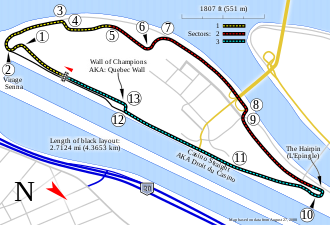
The Circuit Gilles Villeneuve in Montreal is a unique beast on the Formula 1 calendar, a high-speed hybrid carved out of a public park on scenic Ile Notre-Dame. It's not a full-blown street circuit like Monaco or Jeddah, nor a permanent road course like Silverstone, but a demanding mix of both. Its defining characteristics are the two long DRS straights, separated by chicanes and the famous Turn 10 hairpin, which make pure engine power and low-drag aerodynamics paramount. Teams will be dialing back wing levels to maximize top speed down the straights.
The hairpin at Turn 10 is the track's undisputed prime overtaking zone. Drivers brake heavily from high speed, offering a clear shot for a divebomb if executed perfectly. But this stop-and-go nature, combined with the hard braking into the final chicane, makes Canada a brutal test for brake systems. Overheating is a constant threat, especially when battling in traffic, and failures can end a race quickly.
Then there's the notorious Wall of Champions. Exiting the final chicane (Turns 13-14), the concrete barrier has famously claimed the likes of Michael Schumacher, Damon Hill, and Jacques Villeneuve – world champions all – eager drivers pushing just a fraction too wide. It adds a dramatic, high-stakes element to every lap. Tire strategy typically leans towards a one-stop race due to the relatively low degradation, but the ever-present likelihood of a Safety Car, often triggered by a Wall of Champions incident or other contact on the tight confines, can scramble even the best-laid plans. It's a true test for man and machine, drawing a massive crowd of dedicated North American fans every year.